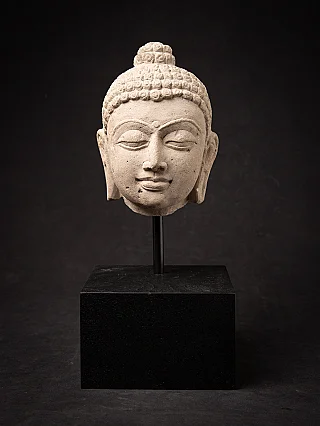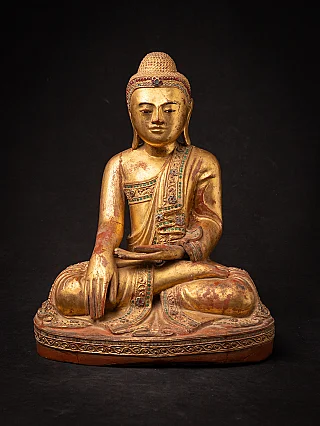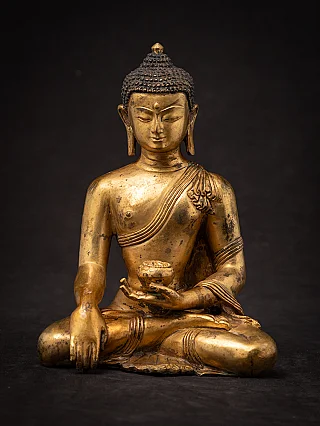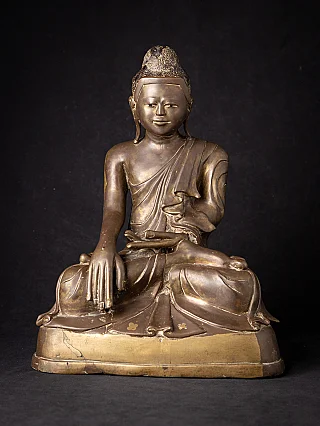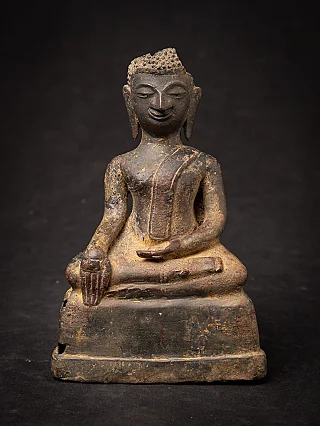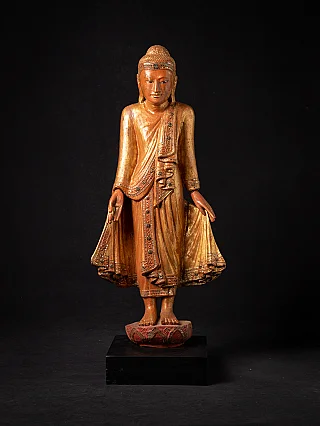
Notable Gandharan Buddha statue

It is known fact that the representation of Buddha images was first used as an icon to spread the teaching of the Buddha. Normally, this was achieved by portraying the life events of the Buddha. In the ancient period, the Buddha was not portrayed instead used symbols like an empty throne. These types of images were categorized as an aniconic phase in the Buddhists art. It was because the artists never used the image of the Buddha in their artworks. There is general belief that the Buddha himself direct his followers not to use his image but instead focus on the teachings.
After the aniconic phase, nearly 500-600 years later, the Buddhist art form was revolutionized as it was added with the Buddha images. These images were then categorized as an iconic phase in the Buddhists arts due to the Buddha images in the Buddhists art. It was seen that these images were initiated from two different regions in the ancient India - Gandhara, and Mathura.
Historical account of the Iconic phase of iconography
Mathura art was started by the artists from the city of Mathura, in central northern India. It is recorded that the art of Mathura is contrasted with the Gandharan art. It has been recorded that the art of Mathura has based on a strong Indian tradition. The images created by Mathuran artists included anthropomorphic representation of divinities such as the Yaksas along with the Buddha. In Buddha Statues, the Buddha is portrayed with thin muslin covering the left shoulder, the wheel on the palms, the lotus seat, etc. But this art form got new medium during the period of Gupta dynasty. The statues were created through a pink sandstone.
On the other hand, the Gandharan were more influence with the Greco culture. Therefore, the arts that they made have an influence on Greek and Buddhism culture. The Gandharan Buddha statues usually were depicted in a gesture of benediction, with the right hand held at shoulder-height with the palm facing forward and the fingers together and slightly bent.
It was also documented that both the region; Gandharan and Mathura; had strongly influenced each other. There was also a debate whether the anthropomorphic representation of Buddha was a result of the local evolution of Buddhist art at Mathura or a consequence of Greek cultural influence in Gandharan. Whatever may be the actual answer no one can deny that these two areas are responsible for revolutionizing the Buddhist art.
Notable Gandharan Buddha statues
It has been already clear that Gandharan statues are simple and has been influenced by Greco Buddhist culture. Among numerous statues, there are two of them that are most notable and is appraised by every art lovers as well as Buddhists followers. These statues are Standing Gandharan Buddha statue and Seating Gandharan Buddha statue.
Standing Gandharan Buddha Statue
The Standing Gandharan Buddha Statue is believed to be dated to 1st or 2nd Century CE. This statue is currently preserved in the Tokyo National Museum which is a remarkable example of Greco-Buddhist Sculpture. It has been documented that the standing Buddha was sculpted using the specific Greek technique. They used marble to make the hands and feet with the purpose to increase the realistic effect while other material for the body. That's why most of the art lovers regard this statue as the most beautiful, and probably the most ancient Buddha statue.
Seated Gandharan Buddha Statue
The Seated Gandharan Buddha Statue was discovered at the site of Jamal Garhi in ancient Gandhara. It is believed that this statue dated to 2nd or 3rd century CE. The statue was carved in schist with the purpose to carve a very fine details like the fingernails. The statue is portrayed in Dharmachakra Mudra. The statue is seated on a cushion on a throne. The front of the throne is carved with the smaller figures of a bodhisattva with a turban and halo, flanked by kneeling figures of a male and female.
Note: Apart from maintaining the blog on Buddha and Buddhism, we also manage huge collection of various period and regional Buddhist arts in our Buddha shop in Netherlands and also showcased it in our online Buddha statues gallery. Please feel free to visit and know more about the Buddha statues.
Share this page



-small_webp.webp)